

The challenge: every campaign was a spreadsheet, and every Friday was a fire drill.
Y Strategy runs door-to-door canvassing for political campaigns, advocacy groups, and ballot initiatives — often three, four, or five clients at the same time. For years, Mykle Tomlinson and his field director Alex Wright pieced together every campaign by hand: the schedule lived in a spreadsheet, canvassers texted in their hours, and the breakdown of who worked on which client got reconstructed at the end of the week from memory, notebooks, and group chats.
It worked. It just took forever. Every invoice meant pulling timecards apart by hand and matching them back to the right campaign, and every client wanted to see exactly where their dollars went.
Finding software built for the way field teams actually work.
Mykle had tried generic scheduling tools and time-clock apps. None of them understood the core problem: a canvasser might work for three different clients in the same week, and every minute of that time has to be tagged to the right campaign — for payroll, for invoicing, and for the report the client expects on Monday morning.
teamsly was the first app the team tried where the client wasn't an afterthought. Canvassers pick the client they're knocking doors for that day, and from that single tap the schedule, the time clock, and the reports all line up automatically.
Before teamsly, every Friday I was rebuilding the week from texts and memory just to send invoices. Now the hours are already tagged to the right client the second a canvasser clocks in.

One schedule for every canvasser, every client.
Alex builds the weekly canvassing schedule in teamsly from shift templates — one per campaign, one per turf. Canvassers get a push notification with their week, see exactly which client they're working for each day, and where to report. Open shifts get filled from the team chat instead of a frantic round of phone calls.
When a campaign ramps up or a new contract drops in, Alex can spin up a new client, build out the shift templates, and have canvassers assigned the same afternoon.
The "client" tag that changed everything.
This is the feature Y Strategy uses harder than any other Teamsly customer we know of. When a canvasser clocks in, they pick which client they're canvassing for that day. That one selection ripples through the whole platform:
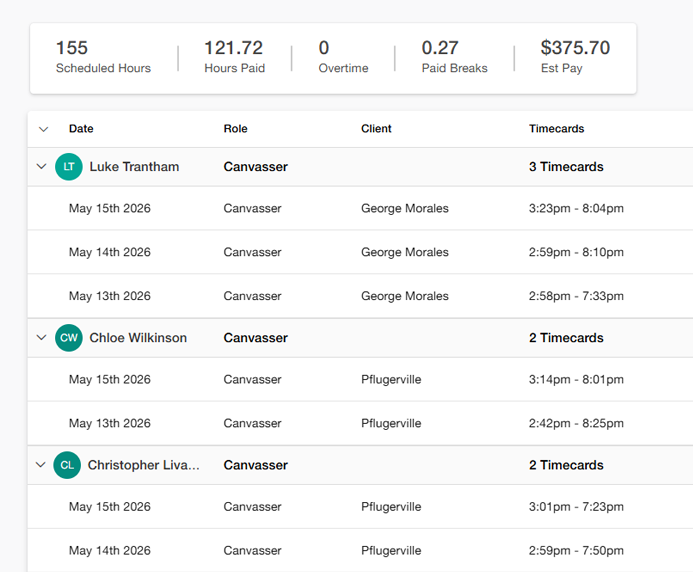
- The timesheet shows every shift grouped by client, with the exact start/stop times.
- The cost report rolls up wages by client, so Mykle can see — in real time — exactly how much each campaign has spent so far this week.
- The client report Alex sends out every Monday is filtered to just that client's hours, with names, dates, and totals.
Before teamsly, that breakdown was a Friday-afternoon spreadsheet project. Now it's the byproduct of canvassers just doing their job.
GPS on every shift, time clock on every phone.
Canvassers clock in from their phone the moment they hit their turf. While they're on the clock, teamsly tracks their location, so Alex can open the live map and see exactly who's where — without sending a single "you out there?" text. If a canvasser is off-turf or stuck somewhere they shouldn't be, he sees it immediately and can radio them on chat.
The geo-fenced time clock keeps punches honest, and because the location is tied to the shift, every disputed hour has a real answer — not a guess.
Y Strategy went from spending Fridays piecing invoices together by hand to sending full client reports in a few clicks — and Mykle finally has a real-time number for what every campaign is costing him.
5×
faster client reporting versus the old spreadsheet workflow
100%
of canvasser hours tagged to a client at clock-in
Custom reports clients actually open.
Every campaign wants its own view of the data — total hours, hours by canvasser, hours by day, dollars spent to date. Alex built a handful of custom reports in teamsly, one per client style, and now he runs them on demand. Export to PDF or CSV, attach to the email, send.
The reports clients get are clean, branded, and ready to drop into a board update. The work behind them is almost entirely gone.
Chat, announcements, forms, and quizzes for the whole team.
Field teams change fast — new turf, new scripts, new compliance rules from a campaign manager who just called. The team chat keeps day-of changes flowing to the right canvassers in seconds instead of waiting for a group text to make the rounds. Company-wide announcements handle the bigger stuff: a new policy, a kickoff for the next campaign, a shout-out for the canvasser who hit their door goal three days in a row.
Forms and quizzes are how Y Strategy onboards and certifies canvassers without dragging everyone into a conference room. New hires complete a script quiz before they go out. End-of-shift forms capture issues from the field — a busted clipboard, a hostile neighborhood, a doorhanger that ran out — and everything stays timestamped against the canvasser and the client.
I used to spend hours every week chasing canvassers down and asking "where were you and who was that for?" Now I just open teamsly.

The results.
- 100% of canvasser hours tagged to a client the moment they clock in — no end-of-week reconstruction.
- 5× faster client reporting — what used to take days of spreadsheet work is now a one-click export.
- 8 hours a week reclaimed by Alex on scheduling, location-checking, and timecard reconciliation.
- Real-time campaign spend visible to Mykle on every active client.
What's next for Y Strategy.
With the field operations running clean, Mykle and Alex are leaning into the data side — pushing more campaigns through the same playbook, adding canvassers without adding back-office headcount, and giving clients tighter, faster visibility into what their dollars are buying door by door.